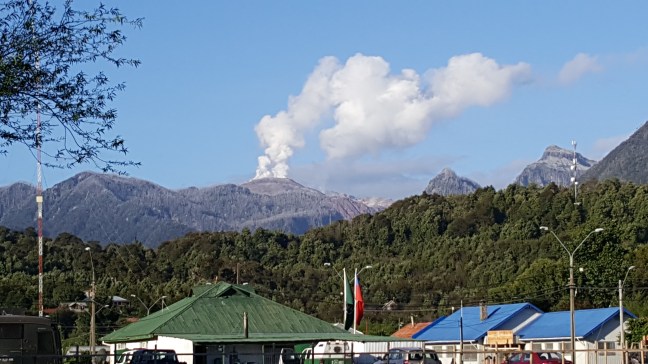
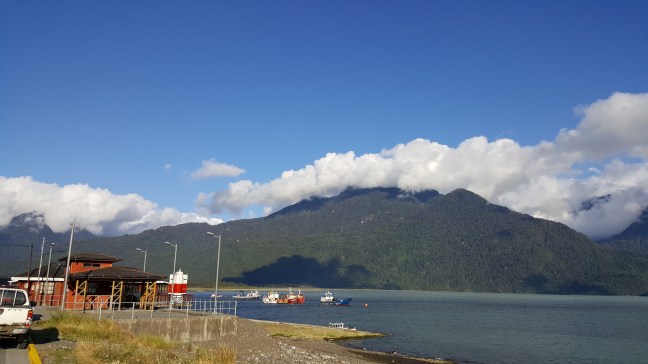
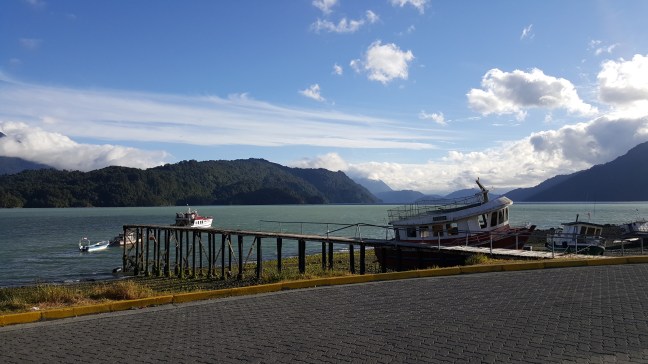
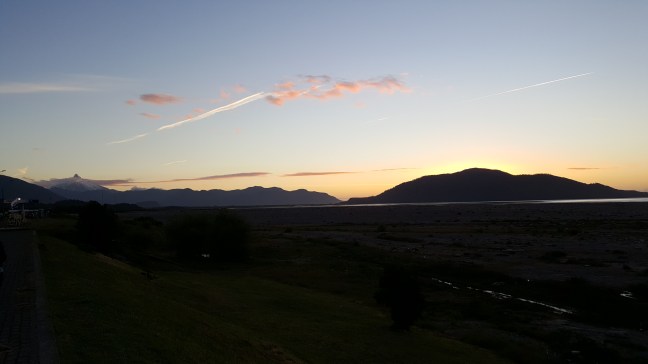
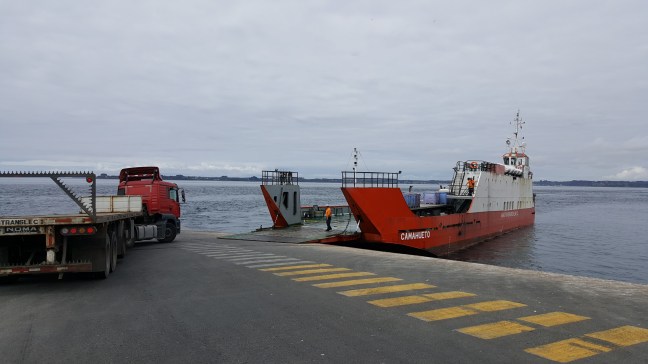
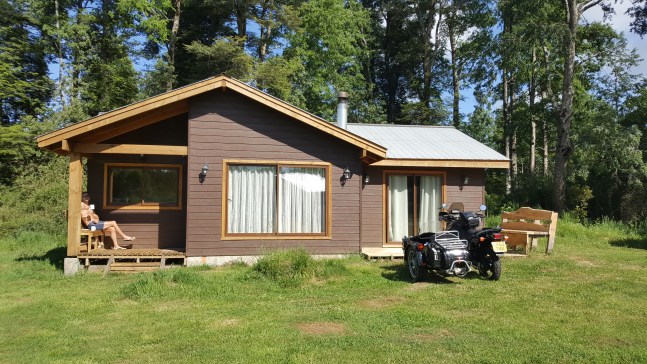
We had a lazy day today – the sun was out so we chilled both sitting outside our cabana and strolling around the town, along the seafront, and to the port area where we’ll get our ferry to Chiloe tomorrow. There was actually quite a lot going on – after the nearby landslide of Saturday, helicopters continued to fly overhead all day, with a number landing next to the local Carabineros HQ which was a (long) stone’s throw away from us.
Apparently, the helicopters had been ferrying survivors from the landslide area into Chaiten where they had been sent onwards. The other interesting activity concerned the local volcano, Volcan Chaiten, which had recently started smoking. It last erupted in a big way in 2008, with the town’s inhabitants having been evacuated.
We also bumped into the owner of the aged Africa Twin we saw yesterday. He – Juan Garcia – was a year and a half into a round-the-world trip, having come from Spain via Europe, Russia, Alaska, Canada, USA, Central and South America. He was heading for the Fin del Mundo, as we are, so our paths may well cross again; in fact they will tomorrow at the least since we are both getting the ferry to Chiloe to enable us to continue south, what with the Carretera Austral now closed for possibly a couple of months due to the landslide.
We have now made our plan to head south – we get a 4-day ferry from Puerto Montt (a hundred miles or so to the north of where we are now) to Puerto Natales which is in the southern part of Patagonia, quite near to the southernmost tip of Chile. The ferry sails through the Chilean fjords and out into the Pacific Ocean at one point, with penguins, whales, condors and other interesting wildlife to be expected. We have talked of doing this a number of times and it was the closure of the Carretera Austral which led to this decision; and we can still ride through Patagonia on the northward return. We leave on the 22nd and arrive at midday on Christmas Day where we have booked a nice-looking place for a day or two. Then it’s onto the Tierra del Fuego and the Fin del Mundo (End of the World).
Day 20 – Calen to Hornopiren
We were up early today as we had a long ride ahead of us. From Calen we had to ride back up to the north of Chiloe in order to catch the ferry back to Pargua, on the mainland, and then back to Puerto Montt again. It was a wet and misty day so despite having waterproofs it was a miserable 60 or so miles in the constant rain to the ferry. Luckily, we rode straight onto it and were back in Puerto Montt in good time. We continued our journey, joining the Carretera Austral just south of Puerto Montt, and headed for the little port of La Arena to catch a small ferry which took about half an hour to get to another little port, Puelche. From there, we headed for the larger town of Hornopiren where the next morning we would take a 2-stage ferry to Caleta Gonzalo.
Hornopiren
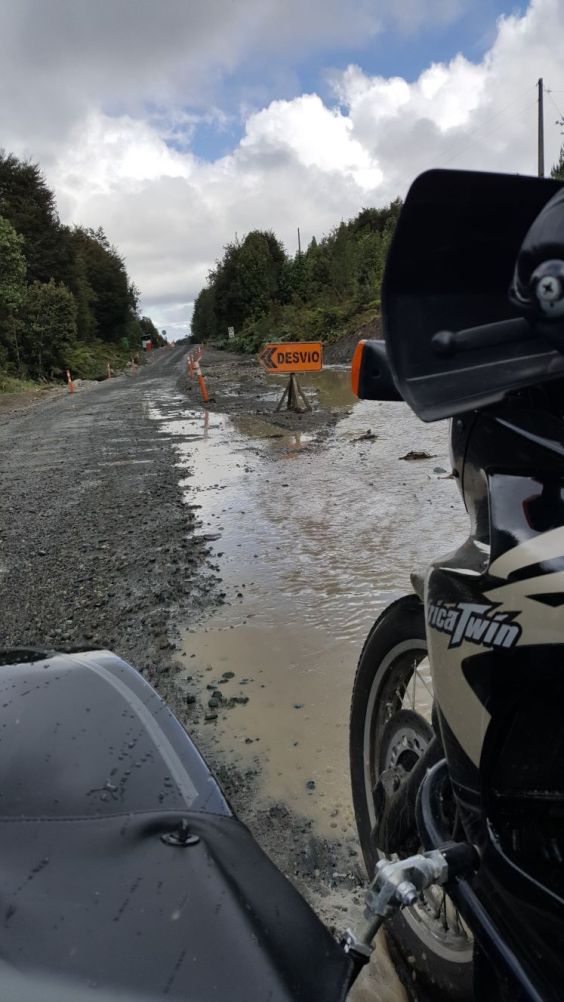
On the way to Hornopiren, Mark had some more fun taking the sidecar off the paved road, as much of the road to Hornopiren was a muddy, gravelly surface for several miles with dips, huge puddles and slippery wooden bridges. What made it more scary for me were the huge trenches at the side of the road, but we took it steadily. There were a few other vehicles on this stretch of road, mainly huge lorries charging along, and 4×4’s which usually overtook us at speed. We turned up the Scottoiler (the automatic oiler for the bike’s chain) to help protect it from all the grit and debris from the road which was flying everywhere as we rode along. It was a bit of a relief to get onto tarmac, only to find it was a small section and we were then back onto the unmade road again for more miles! Believe or not, this is the one and only continuous road accessing the whole of southern Chile:
The road to Hornopiren
We eventually arrived at Hornopiren in the late afternoon and filled up the bike and spare fuel can as petrol stations will be more scarce where we are heading, and then checked into our Hostel for the night. This was very near the ferry terminal so an ideal position as we had to be there the following day to book in at 8.30am. Day 21 – Hornopiren to Caleta Gonzalo
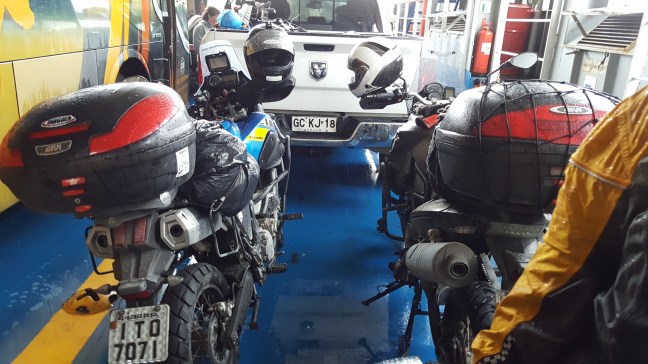
We were up early and waited with other passengers to book in – it was very busy and we had to take a numbered ticket and wait our turn to get our tickets which we’d pre-booked on-line. Luckily, our reservation was fine so we grabbed our tickets and embarked. Whilst waiting, we got chatting to an English couple, Sally and Andy, who were cycling the route and who by chance we had overtaken yesterday….the only time we overtook anyone all day! We received a lot of attention from the ferry crew who swarmed round the bike and were asking where we were from and how we got the bike to Chile. We passed some time chatting with Andy and Sally, along with some other motorcyclists – two from Brazil riding a BMW 800GS and Yamaha 660 Tenere, and a German couple on a BMW 1200GS.
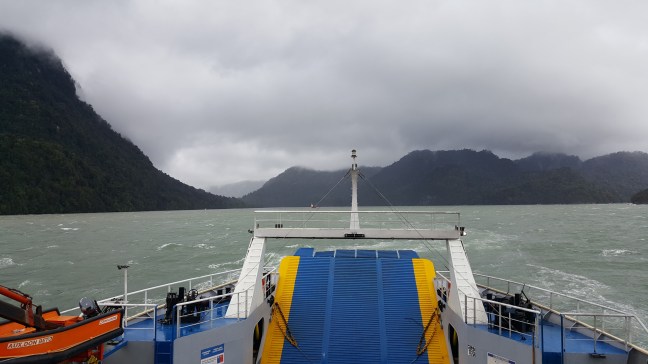
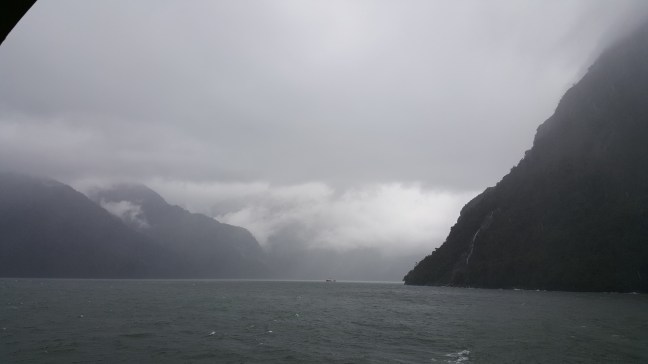
Heading to Gonzalo….
….in the Chilean fjords
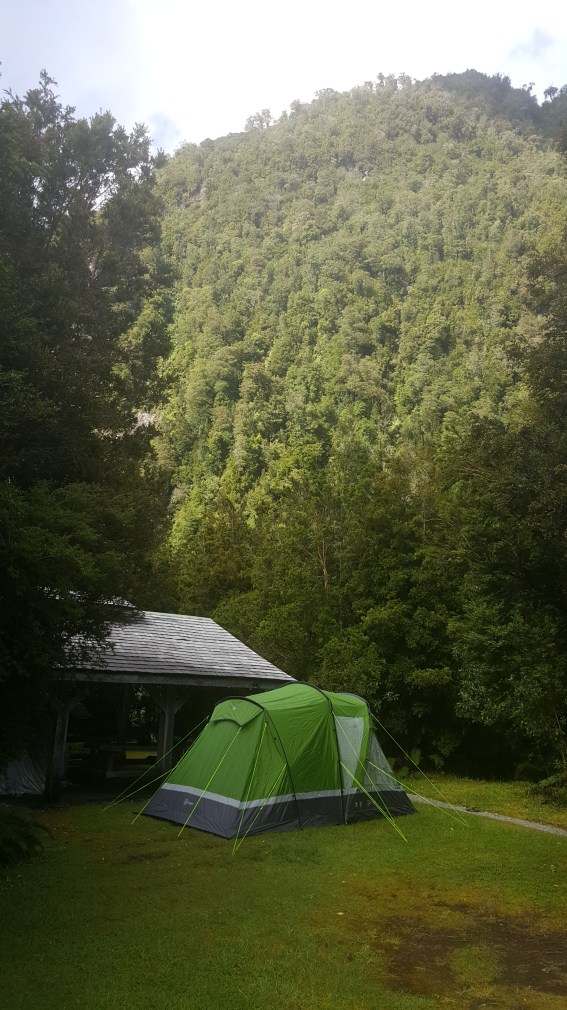
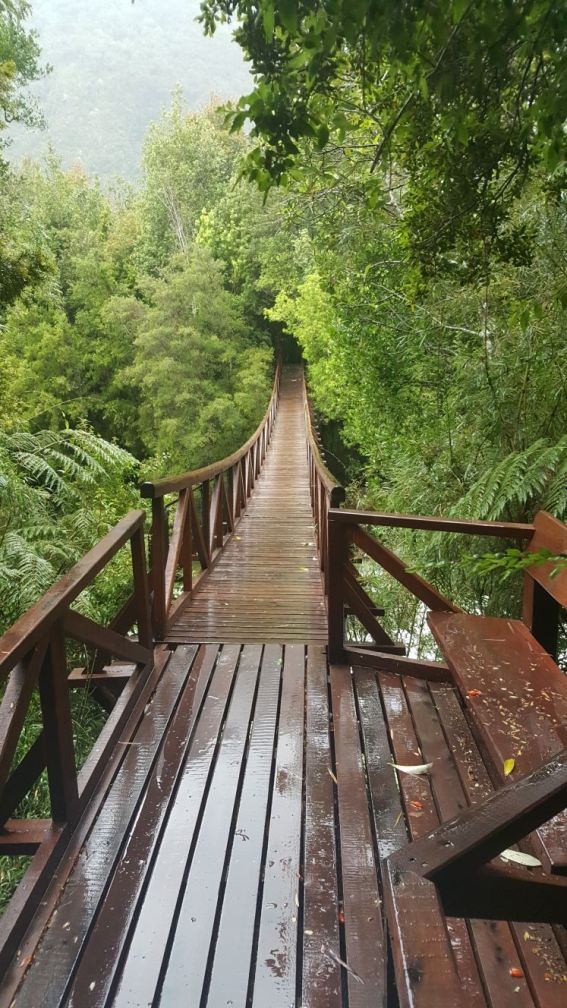
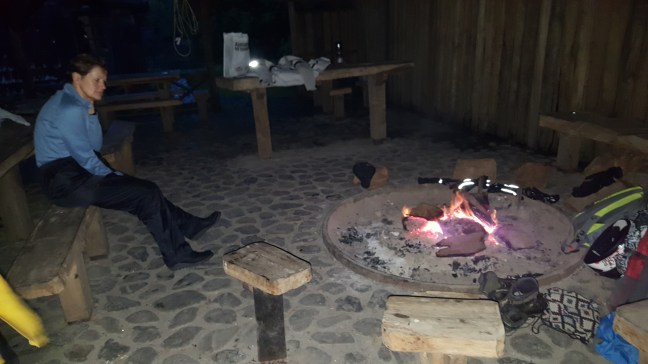
A 10km unmade road linked the 2 ferry stages, which totalled around 5 hours from start to finish. After disembarking at Gonzalo, we checked out a campsite a couple of hundred metres beyond the port. It was within the beautiful Pumalin Park which comprises some 3000 hectares of untarnished temperate forest. As it had stopped raining, we decided to camp there for the night – luckily, we managed to erect the tent just before the rain returned in torrents which continued all through the night. The noise of the rain on the tent, along with noise form the fast-flowing Gonzalo river nearby, was intense but a good test for a first night in our new tent. After sorting ourselves out, we walked over to a very welcome fire pit area to warm up and try and dry some of our wet things. Other campers from Chile, France and Israel were doing the same. Sally and Andy had stopped off here too, so it was a lovely atmosphere all chatting together and preparing our suppers by the fire pit.
Home for two days….….approached via a rope bridgeThe much-welcome fire pit
Day 22 – At Gonzalo
After raining for the whole night, it continued for most of the day. However, we found a café a short distance away and warmed up sitting next to their open fire and had a bite to eat. By midday, there was a break in the weather so we said goodbye to Sally and Andy who had joined us for lunch as they were heading on towards Chaiten, about 58 km away, on their bicycles. Hopefully we will meet up again in due course.
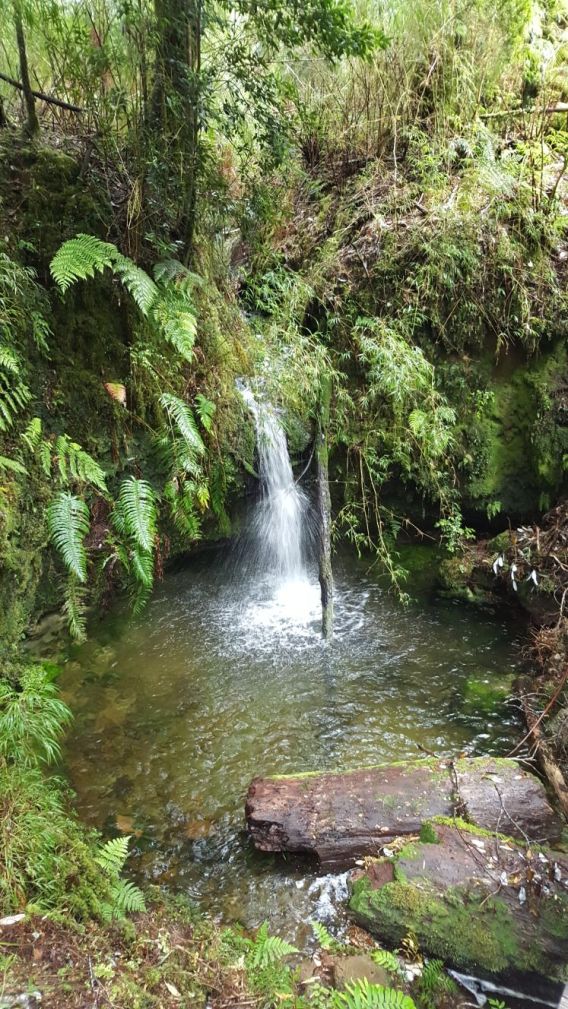
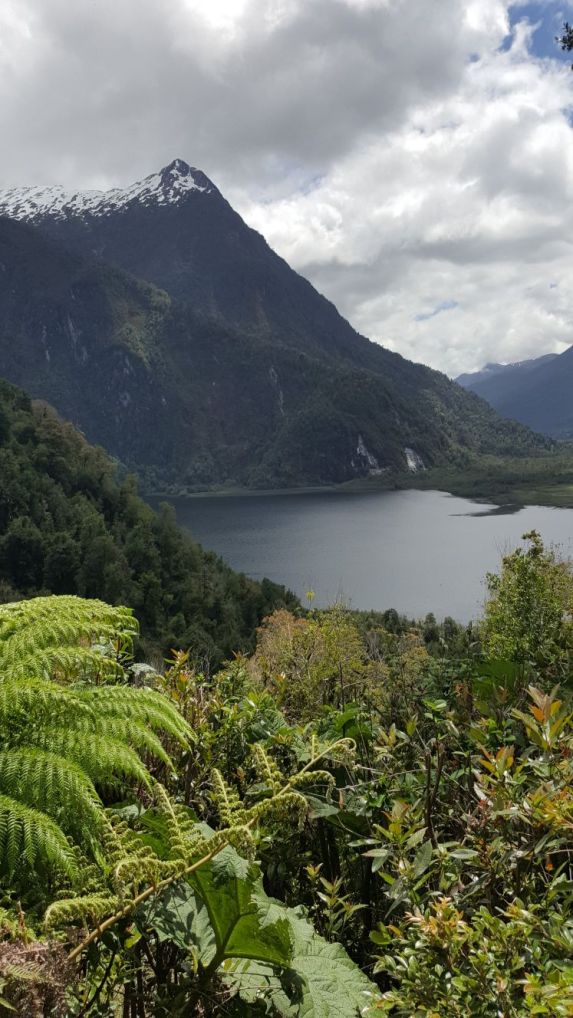
After lunch, it stopped raining for a while so we decided to check out a local trail to which led to a series of nearby cascades. The lush vegetation with ferns, huge Alerce Trees and gentle streams was a beautiful sight. But, when we were nearing the top it started raining heavily again which prompted an early descent. Whilst we saw a number of small waterfalls we’ll never know if there was something bigger further up!
Day 23 – Gonzalo to Chaiten
We awoke to a recently rare site – the sun. Given that dismantling the tent would be easy in the dry, we decided to pack-up and move on to Chaiten, some 58km south, the last sizeable town before Coyhaique, a few hundred km to the south. The road to Chaiten was largely unmade, ranging from a well-compacted and level surface to shorter stretches with deep potholes, ruts, loose stones and mud. Roughly at the mid-point, several km’s were in the process of being paved and thus we had a billiard table ride connecting the pogo-stick (but fun) start and finish rides.
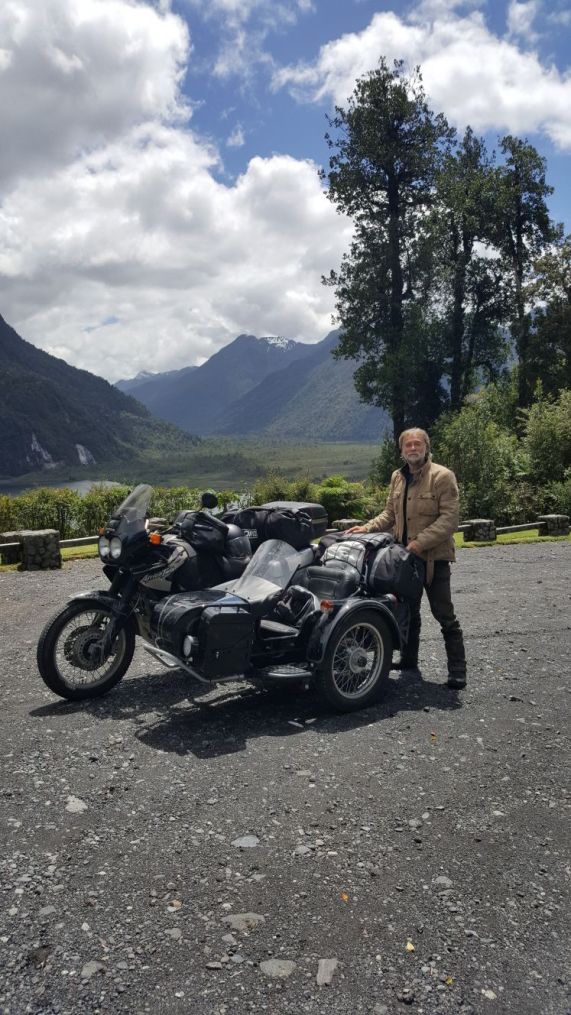
Stopping en-route to Chaiten….….at a glacial tarn
On the way to Chaiten we had to stop at a red light where road improvements were being undertaken. The workman operating the lights, as well as asking for a photograph of himself with us and the bike, asked how far we were travelling since there had been, on the previous day, a disastrous landslide which had all but destroyed the next town beyond Chaiten, Santa Lucia, with the result that the Carretera Austral had been closed and would remain so for an unspecified period of time, possibly weeks. As it happened, the next crossing over the Andes to Argentina was at Santa Lucia, and thus we couldn’t cross there to continue south. We therefore have had to review our options of which there are two – first, to re-trace our steps back along the Carretera Austral to Puerto Montt, complete with 3 ferry crossings; and second, to get a ferry Chiloe (where we were staying a few days ago) and then ride back up to Puerto Montt from there. We’ve decided on the latter since it will take less time and will enable us to press on south – this time on the famous Ruta 40 in Argentina.
Upon arriving at Chaiten, we booked into a great Cabana on the seafront. Numerous helicopters have been flying overhead, which we assume is to do with the rescue operation at Santa Lucia where five persons have perished and sixteen are missing. It has made us think….had we not decided to camp at Gonzalo we would have been two days ahead and may well have been near to or even at Santa Lucia when the landslide occurred.
Whilst taking a walk around Chaiten, we spotted a well-used Africa Twin, an early RD04 model, which appeared to be on a round-the-world trip. Unfortunately, the owner was not around as it would have been interesting to hear more of the trip (and the bike).
After chatting the previous day with Ivan, we decided not head straight for the Carretera Austral. Rather, on his recommendation, we would make our way south-west to the island of Chiloe, a couple of hours’ ride from Puerto Montt.
We headed to Pargua, the small port where we could board the ferry which would take us to Chiloe. The crossing took around 45 minutes at a cost of around £10. During the crossing, there were dolphins nearby, and a flock of Pelicans flying overhead – a common sight for locals but exicting for us.
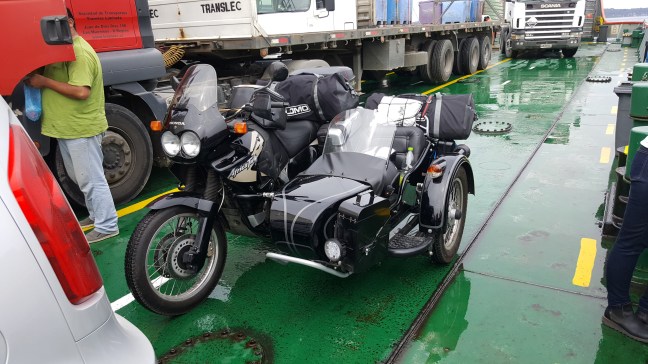
Boarding the ferryThe only bike on board
Our destination was the small sea-side village of Calen, a 50 mile ride to the eastern side of the island where we’d booked our accommodation for the next 2 days – staying with a Chilean couple, Andrea and Daniel, in their beach-side cabana. En-route, we stopped at a roadside café and ate an enormous chicken and rice lunch within a room full of very friendly construction workers who were repairing the road. As now usual, one introduced himself and had a bit of a practise of his English. The last 5km of the ride consisted of a steep, unmade road leading down to the sea; apart from the (flat) 200m bridleway leading to our house, this was the first time the bike & sidecar had been off the paved road. This was the perfect surface to test out the replaced sidecar bolt, which remained firm!
Our current homeWith view from the front room towards The Andes
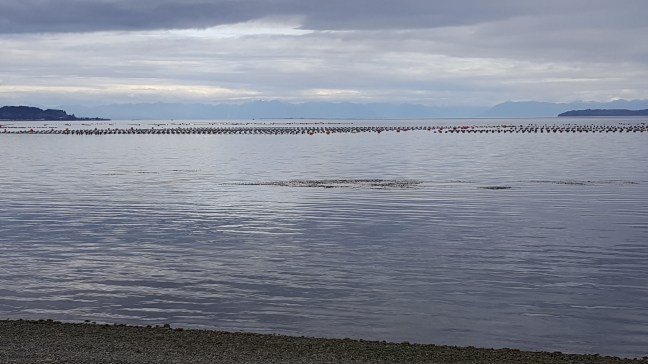
In the photo above, you can just about see where a salmon farm is located on the left side, and more so where mussels are harvested below the floats elsewhere. We have now booked our ferry crossing at the start of the Carretera Austral, from Hornopiren, for Friday morning, so will leave here tomorrow and head there via Puerto Montt.
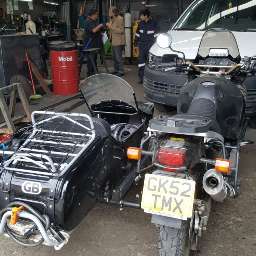
After breakfast, we rode to the welding shop and asked for Harry Meyer, the owner. As it happened, he arrived in his pick-up just after we arrived, along with an Italian colleague, Luigi, who spoke good English and to whom we explained the problem with our bike, i.e. the stripped thread on one of the sidecar connecting points. He suggested that it would be far better to detach the sidecar and replace the defective threaded section rather than weld a piece of metal over the defective connection. We agreed with this. Our kind host of yesterday, Rodolfo – Harry’s brother – then arrived and took charge of the matter. The welding shop, as we’ve termed it, was actually a sizeable engineering workshop with a number of lathes and other pieces of metal-working equipment, all of which instilled some confidence in the repair process which was about to begin.
It was going to take a few hours, so although a bit anxious about the procedure, we decided to wait in a small café opposite the workshop. After several cups of coffee, some sugary doughnuts, and getting out our crossword book, the time went by surprisingly quickly. Luigi came in to buy some lunch and we chatted for a while about his past involvement with bikes. He apparently used to test ride Suzuki and Yamaha bikes for Italian racing teams before the races, at a time when the late Barry Sheen was in his prime. He had even ridden the Isle of Man TT races, and had had a very interesting past. Then, another person entered the café….we both recognised him to be Ivan, the motorcyclist we’d chatted to at the Pan-American Highway services a few days earlier on our way to Puerto Varas! None of us could quite believe it and all the more incredible was that he had known Rodolfo and Harry Meyer and their father for more than 20years! He invited us back to his house, which actually fronted the Pan- American Highway and was about 10 minutes away, to continue our wait as the welding shop had closed for lunch.
We listened with interest as Ivan described how he’d been detained for six months by the Pinochet government, possibly because of his family left-of-centre views, but he had done nothing wrong himself. Following his release, he had exiled himself to Canada (his mother was French Canadian) and had stayed there for a number of years before returning to Chile. He had become a successful Civil Engineer with homes in Lican Ray, Puerto Montt and Chiloe, and was now retired. What a small world….with Puerto Montt being a town of some 250,000 inhabitants, the chances of bumping into Ivan were pretty small!
When we returned to the garage in the mid-afternoon, the bike was ready and had been cleaned and polished. Rodolpho was amazed to see us with Ivan, so we explained how we had met. When we asked for the bill, he insisted that he only wanted a token amount for the repair which was very kind of him. We said that if his son ever came to England, as he apparently wanted to, he could stay with us, given that his father had been so helpful and kind to us.
Once we’d left our nice hotel in Puerto Varas, our first stop of the day was at a local motorbike repair shop we’d found via Google. The owner was just locking-up as he wasn’t open for long on Saturday mornings – it was only around 10.30am. He was very helpful and gave us the name and number of a specialist automotive welder he knew in Puerto Montt. Once there, we set about finding somewhere to stop to have a drink with Wi-fi in order to book accommodation for a few nights. This proved more difficult than one would have expected and after riding around for a while we headed out of town and spotted a small hotel that looked fine. It was more than fine as the room was in fact a little bed-sit complete with small kitchen area, table & chairs, sofa and bathroom, with breakfast being provided inclusively, and all at a very reasonable price.
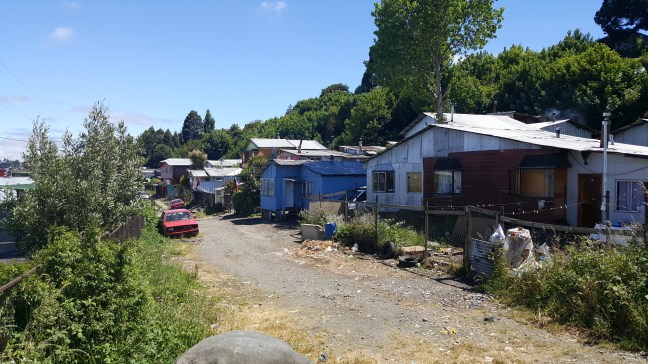
The town, Puerto Montt, is a busy ferry and bus terminal for people heading down south into the fjords and onto Puerto Natales which is at the very south of the country. The south road, or Carretera Austral, is not continuous all the way so ferries have to be taken and there are several options which we have yet to decide upon. We have a large supermarket (called ‘Jumbo’) just down the road from our hotel and paid it a visit to get provisions for supper. We’ve been surprised to see that nearly every supermarket and pharmacy we have walked past in Chile so far has had security guards at the entrances and exits, and yesterday we walked past a Vet’s practise which was secured with about a dozen padlocks on the door to prevent intruders stealing the drugs, we presumed! So far we haven’t felt at all threatened when walking about, despite some areas being very seedy and not at all like Sandwich or indeed anywhere in our part of the world (Dover and Thanet included)! There are certainly some very beautiful areas in both town and countryside albeit a common street scene would be more like this:
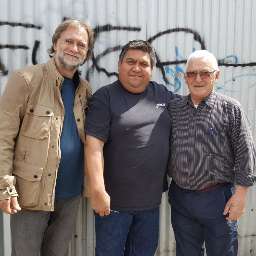
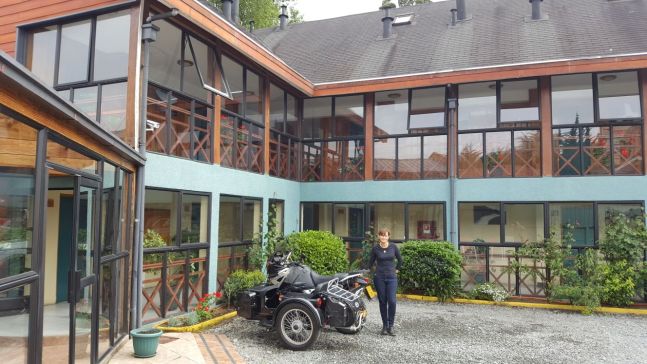
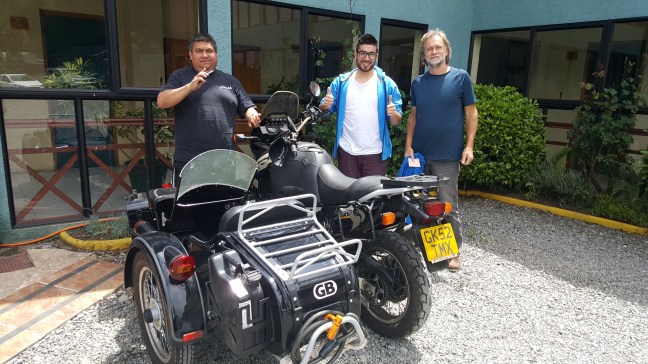
Today (Sunday) we headed out to find the automotive welding shop we’d been recommended, and were anticipating this to be a bit of a boring task. However, when we located the address it was in the middle of a residential area and far from what we were expecting. By chance, a woman was taking-in her shopping from her car and it turned out that she was the sister-in-law of the welder. We ended up being invited into her house and chatted about the problem with her husband (also a mechanic) over coffee and strawberries in their kitchen! To top it all, Rodolpho and his son took us in their pick-up truck to show us where the welding business was, and then took us back to our hotel! We were so grateful, but they genuinely seemed to enjoy talking and helping us, and we finished off with another photoshoot in the carpark of the hotel.
Tomorrow we head to the welding shop and then, hopefully, on to book the ferry we’ll need before we start heading south.
Mark’s note for vehicle lovers:
There are loads of pick-up trucks of all makes and sizes from small Fiats and VW’s (which seem to be derived from hatchback cars with the rear portion cut off) to huge US Dodges, Chevrolets & Fords, with many Japanese plus some Chinese and Korean brands as well. I want a pick-up when we get back!
There are many Korean cars (Hyundai and Kia), along with a number of Japanese makes and quite a few Peugeots. The Renaults we’ve seen here are branded as Dacia back in the UK. We’ve seen very few so-called luxury cars such as BMW and Mercedes; I get the impression that people go for big pick-ups instead.
Most motorbikes are small capacity, the majority being Chinese albeit there are a number of Japanese as well. We’ve seen very few medium- or large-capacity bikes, probably only around a couple of dozen over the last two weeks – a few BMW GS’s, a KTM or two, a few cruisers, a couple of sports bikes, and I think one Triumph Explorer. Two Africa Twins have been spotted so far, both being the old (original) model like ours.
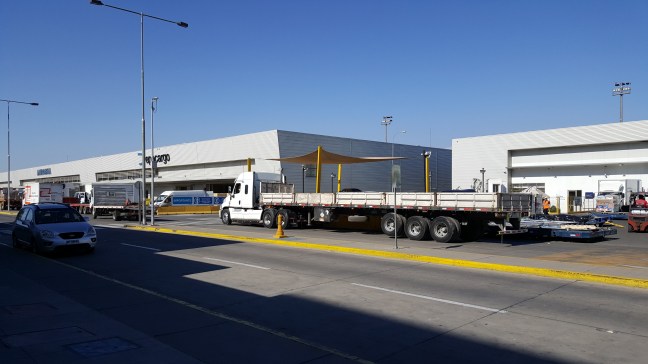
There are a lot of proper lorries here, namely the ones with long, protruding bonnets and a more menacing look than their European-style, flat-fronted cousins. Some of the bonneted variety are in fact European brands such as Volvo and Mercedes, along with US brands Mack, Freightliner and Kenworth. Some of the articulated trailers are excessively long, at least by UK standards, probably around 50% longer than at home:
We left our Cabana in Lican Ray reasonably early and followed a scenic tourist route towards Ruta 5 which leads to Puerto Montt, a large port located to the northern end of the Chilean fjords which run down to the southern-most tip of the country. We rode through extensive forested areas on said tourist route, complete with wonderful views and a number of hairpin bends. We stopped for fuel on Ruta 5 and got talking to Ivan, a very spritely 74 year old biker with a BMW 1200GS. He spoke fluent English (having been born of a French-Canadian mother) and coincidentally lived in Lican Ray – our last stopover – but today was riding to Porto Montt. We exchanged contact details and he very kindly said if we needed any help or a place to stay, should we be back in Lican Ray, we must contact him!
We arrived at Puerto Varas and spent a couple of hours trying to find the Airbnb cabana which we’d booked the previous day, since the owner had provided very poor directions; we’d messaged her the day before with no reply and telephoned many times on the day with no response either, so were unsurprisingly becoming concerned. We headed for a café to use their Wi-Fi, only to find a message from Airbnb saying that she had cancelled the booking one hour before our arrival time! Airbnb support were very helpful and gave us a list of alternative places but by now it was 7pm and we didn’t want to have to book another Airbnb property with all the associated waiting for confirmation etc. Our waiter at the café was very helpful and mentioned that there were many cabanas and hotels further along the road and that we should have no problem getting somewhere to stay.
As it happened, we found a great Hotel which had rooms with views over Lago Llanquihue, the huge volcanic lake next to Puerto Varas, and including breakfast cost a meagre £38 a day for both of us. Whilst the hotel was a bit tired around the edges is had a faded charm and certainly had incredible value….some of the lakeside Hotels we had seen on Booking.com earlier, when trying to find somewhere after our cancellation, were well over £200! We were relieved to have found something that was probably better than our cancelled booking and celebrated with Pisco Sours and Pizza at a nice Italian Restaurant just down the road.
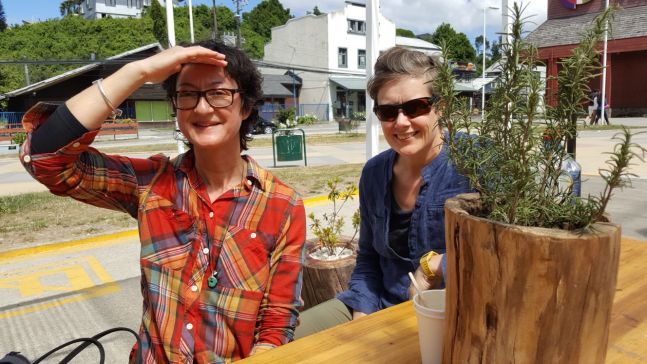
The next day we walked into the town and found camping gas canisters for our Jetboil stove (these canisters were not allowed on the plane), and then bought lunch from a pop-up Turkish street food van. Whilst sitting eating our tasty Falafel and Carne concoctions, we heard an unusual sound – English voices, and this is where we met 2 adventurous girls, Maresha and Caron, who were travelling around South America together in a pick-up truck. They were from London, and we chatted for a while about our respective routes and other such matters. Like us, they had fairly recently started their trip and are heading roughly in the same direction as us, so hopefully we may meet up again somewhere along the way.
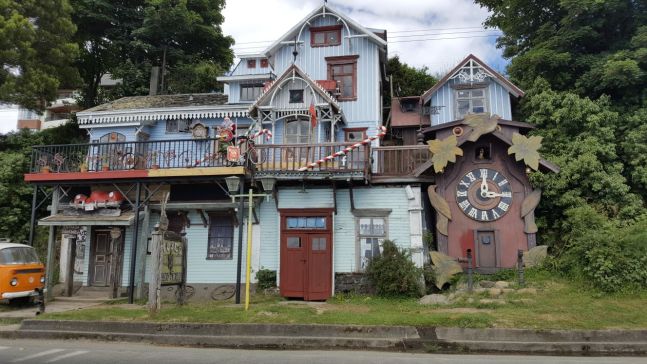
On the way back to our hotel, we visited an extraordinary museum full of quirky artefacts and brilliant paintings by an artist named Pablo Fierro. Apparently, he had been given the building – a former water pumping station – several years ago by the town council when it desperately needed refurbishing so that he could display his work for locals and tourists alike to see. He had now refurbished the building and had added various extensions to make it into a maze of exhibition rooms for his paintings and collection of bizarre artefacts which included a number of old sewing machines, wirelesses, and models of Citroen 2CV’s. There were thousands of comment cards displayed on the walls, all left by previous visitors, and we added 2 more…. unfortunately, we couldn’t fully understand most of them as all were written in Spanish (and a few in what appeared to be Chinese).
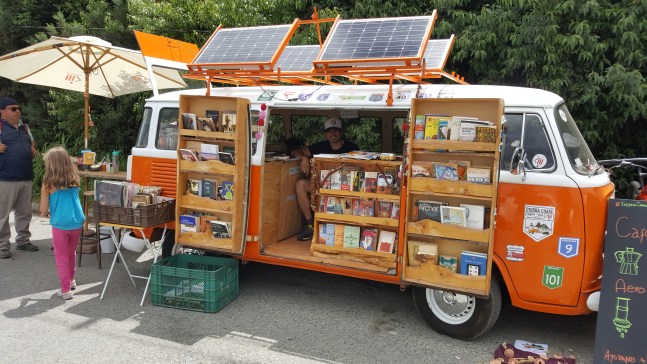
Whilst walking along the seafront, we saw the coolest thing – an old VW camper parked-up, selling books and coffee. We asked if there were any English books for sale – there was one, entitled ’30 Uses for a Dad’ which was probably not a good idea to get!
We left Puerto Varas earlier today and are now at Puerto Montt, the main sea port some 15 miles south, where we’ll investigate ferries which we must take at the beginning of the Carretera Austral. The ferries run once a day and entail two voyages with 10 km of land connecting them, taking around 8 hours in total, with all vehicles having to be pre-booked.
We said goodbye to our hosts and set off towards Ruta 5 (the Pan American Highway) heading south.…it was to be a day of coincidences. When we stopped for lunch, at a service station, we started chatting to three Chilean businessmen who were interested in our bike and the trip. Again, they commented that a sidecar was a very rare sight in Chile and by the number of times we have been honked at, waved to, and videoed as vehicles have overtaken us, we are certainly getting noticed! Shortly after, we met an Irish couple who were travelling around South America with their two young daughters. Debbie recognised the wife and it turned out that they had stayed in the same apartment block as us in Santiago the previous week! They told us, amongst other things, how they had had two lucky escapes, first from a deadly Recluse spider and then from an attempted pick-pocketing, but loved Chile as much we do. Hopefully our paths will cross again.
Our next stop was 60 miles down the Ruta 5 at another service station where we bumped into the same businessmen there as before. They welcomed us to what they called ‘their’ services and it transpired that they were area managers for the Shell Services in this part of the country!
We arrived at our destination, Lican Ray, quite late and after a bit of a search found the Cabana we’d hired for the next two days. Unlike cottage rentals in England, there is often no welcome pack (and there wasn’t here), so we dipped into our emergency food supplies as there were no local shops and we didn’t really want to ride the few miles back into the town after a long day’s ride of some 320 miles.
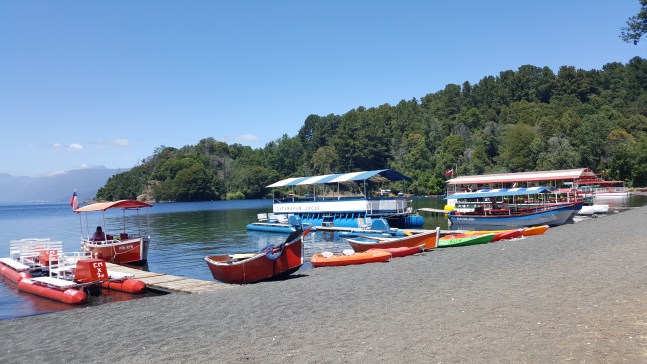
There’s huge lake next to the town of Lican Ray, which we rode to the following morning through picturesque scenery, with Villacarrica Volcano constantly in the background. It’s a huge, active Volcano, with vapours emitting from the top of its volcanic crater. It last erupted in 2015, and as we rode through the town we could see a number of signs for the evacuation route should it erupt again. The lake is beautiful, with an attractive beach front and amazing hills surrounding it. We had lunch at a restaurant overlooking the lake and met a local man at the next table, who had a holiday home overlooking the lake and seemed to know everyone. He kindly arranged for us to join a boat trip round the lake – without charge – which was very unexpected and every enjoyable. It was a shame the commentary was in Spanish, but was an experience we won’t forget. Mark is picking up Spanish quickly and the Spanish we learnt at night school five years ago is slowly coming back – but, the problem is more that the Chileans all speak so quickly!
Mark spent some time prior to our departure checking over the bike before loading-up with the panniers and camping equipment. Whilst checking one of the sidecar fixings he noticed that a nut on one of the front brackets seemed to be a bit loose. On further examination, the thread appeared to have worn, which was very unexpected as this was the first time he had checked the fixings since we took possession of the sidecar. He used some Loctite to help secure it as well as possible, and then marked the nut and corresponding part of the bracket so we could see if there was any movement at the end of our journey.
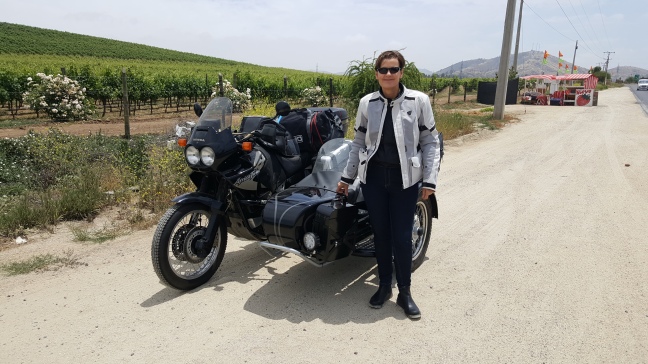
After a photo shoot with our host (who lived next door), we set off for Quinamavida, which is about 185 miles south of Pichelemu, to the inland side of this very slim country. We arrived in the late afternoon and had a very friendly welcome from our new host who showed us to our Cabana (as shown in the photo below), which we thought was good value at £59 a night, found via Airbnb. Our host bought over some homemade raspberry Pisco Sours (our new favourite drink), which we enjoyed on the decking in the sunshine. Her daughter came over shortly after this to check that all was ok, and when we asked her for directions to the local supermarket she insisted on taking us there in her car! Everyone we have met so far have been so friendly and helpful, and this latest show of kindness saved us having to go out and find the supermarket, which was in the neighbouring town, later by ourselves. Mark had checked the bike again when we arrived and everything seemed fine, but decided to e-mail Ben at Watsonian (who had fitted the sidecar), to get a second opinion. His suggestion was, as we suspected, to monitor the wayward nut for movement, and if there is any change then to get it welded in place. We thought about getting that done whilst here, but we are in such a remote area it’s probably best to wait till we are in a large town where the facilities for this would be better.
Tomorrow we are heading south on the Pan American Highway to Lican Ray, a lakeside village near to the town of Villarrica, which is about 280 miles from here.
We are heading south to Pichelemu, a small-ish town on the Pacific coast. Getting out of Valparaiso was almost as difficult as getting in. The labyrinth of steep, twisting narrow roads were confusing to navigate, with one-way streets and no through roads abounding. We stopped to get our bearings and let the bike cool down a bit as much was uphill in first gear, when a friendly local police car came by and ended up giving us a personal escort out of town! We were amazed that the main route out of this north part of town was a narrow, twisting, part gravel road which had confused us somewhat, even when using our sat nav. Anyway, we were soon on the main Ruta 68 heading towards Santiago, before shortly turning off and heading south on more minor roads to Pichelemu. This area is noted in Chile to be the centre for surfing and major international competitions are held here. We rode past a number of vineyards and forested areas for miles, and saw countless fruit stalls by the side of the road, many seemingly in the middle of nowhere. These stalls were selling mostly strawberries and cherries, but unfortunately they wouldn’t have travelled very well with us so we didn’t buy any!
Lunch was another Empanada in a small roadside café, where we chatted with a Chilean chap – whose Welsh grandfather had emigrated to Valparaiso a number of years ago – who was surprised to see an English bike and sidecar parked outside. He told us that sidecars were very rare in Chile and most people wouldn’t have seen one before. This would account for the numerous beeps and waves we were getting from passing vehicles! I felt like the queen waving all the time!
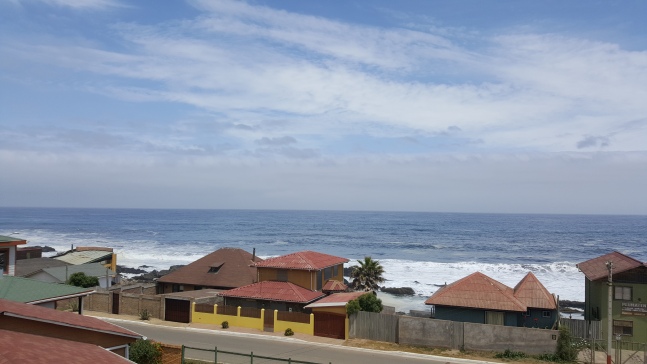
We arrived early at our destination (anyone who knows us well will know how rare that is!). We had booked a cabin (the white unit above) with amazing Pacific Ocean views for 2 nights, just a stone’s throw from the beach. We had secure parking for the bike and planned to spend the next day relaxing on the roof top terrace….which we did. Tomorrow we leave for Linares, around 150 miles ride southwards.
The bike was due to arrive on Tuesday 28th November and we could pick it up from the cargo area at Santiago airport anytime on Wednesday the 29th, so we were originally told. However, when we arrived at the offices of Ultramar (the agents dealing with the import of the bike at this end) at 11.00 on the Wednesday morning, they said that the plane hadn’t landed yet (and that it was due to land at 11.30) and for us to return at 4.30pm. This was going to be a long day…….luckily we had a crossword book so we spent many hours doing many crosswords, wandering around the cargo area watching the planes take off, and the hive of activity as people came to collect their imported goods. We tried our first Empanadas (a sort of Chilean Cornish pasty with meat, egg and olives) for lunch and the time actually went by fairly quickly. Finally, when 4.30pm came, we took our papers to Ultramar and paid the money due, and then set off to the customs office to get the necessary Temporary Import Permit, as without one, we would have a severe problem getting a vehicle out of the country. The customs official serving us didn’t appear to know what he was doing and told us the import permit didn’t need to be stamped until we rode the bike away, despite us querying this matter. As we had thought, when we got to the goods holding warehouse we were told that the permit should have been stamped and we couldn’t progress collection of the bike. The very helpful chap dealing with us kindly went back to customs to sort it out for us – the time was now ticking away and we were getting concerned that we may have to return the next day. Eventually, all was confirmed as being in order and that the bike could be released from the crate.
The warehousemen were almost as excited to see the bike as we were and took pictures of themselves with it, and of us with it! Finally, we were ready to leave at about 8.30pm and now we had to get to Valparaiso, a coastal town some 60 miles away, breaking 2 of our own safety rules on the first day….not to ride at night or to look for our accommodation in the dark. However, we really had no choice and after filling up with fuel rode to our destination. Valparaiso is a large town with 250,00 inhabitants, with the houses being set in a series of steep hills around the working port. The roads were very steep and not well signed which made it very difficult to find the apartment we’d booked. Mark did some amazing U-turns on roads with gradients of around 1 in 10, and with a tight turning circle demonstrating his advanced riding skills(!), only to be seen by a few sleepy stray dogs and undesirables wandering around. Thankfully, when we arrived, the concierge was very helpful and directed us to the underground car park and then up to our flat. By now it was 11.30pm, but at least we had made it there ok and could now start properly planning our onward route in the morning.
Waking up the following morning, we made a beeline for the roof terrace which came with our apartment……the views over town and sea were excellent, as was the view behind us where houses of all colours lined the one of the several hills which make up the town. We wandered into the town to have a look around the port and to have lunch, and to use one of the several funicular railways which provide access to the seafront from the surrounding hillsides.












 Travelling the Americas by motorbike and sidecar